Greater freshwater octopus
| Greater freshwater octopus | |
|---|---|

| |
| S. Magna observed at Lake Scintillant, 140 meters from Santaria, Frésir. | |
Least Concern (CSS)
| |
| Scientific classification | |
| Kingdom: | Animalia
|
| Phylum: | Mollusca
|
| Class: | Cephalopoda
|
| Order: | Octopoda
|
| Family: | Octopodidae
|
| Tribe: | |
| Genus: | Superficies
|
| Species: | S. Magna
|
| Binomial name | |
| Superficies magna Anaëlle Claire, 1913
| |

| |
| Greater freshwater octopus Frésir range. | |
| Synonyms | |
| |
The greater freshwater octopus (Superficies magna), is a large freshwater cephalopod belonging to the genus Superficies.
Description[edit | edit source]
The greater fresh water octopus is a large species of freshwater octopus. It is found in the lakes, rivers, and ponds of Frésir, and Boemont. Adults weight around 40 kg (90 lb.), with an arm span of up to 4.6 m (15 ft.).
Discovery[edit | edit source]
The greater freshwater octopus was first brought to the attention of early settlers by native Frésirians. Settlers thought they were a local legend, or an exaggeration, until 1357 when several octopuses were spotted walking on the coast of Lake Scintillant by Polish settlers. Several octopuses were collected, and housed in local ecologist Aleksander Mirek's personal collection, and passed down as heirlooms until 1763, when half were sent to the National Limnology Museum of Santaria, and the other half were sent to the National Malacology Museum of Myswice.
Evolution[edit | edit source]
It is commonly thought that the greater freshwater octopus started to evolve around 50 million years ago in brackish water, near the southern coast of Frésir. As more tolerance to non-saltine water grew the octopuses traveled farther up rivers and streams. Eventually, they evolved to live in freshwater.
It is unknown if their adaption to freshwater led them to evolve a larger brain, or if the two have no correlation.
Ecology[edit | edit source]
Habitat[edit | edit source]
Greater freshwater octopuses usually live a solitary lifestyle or live in communal grounds where multiple small dens house usually one octopus, although many times if the den is big enough it may house more. Communal grounds generally house up to 10-30 octopuses, the largest communal ground is the grounds at Etterport Conservatory Swamp and Bog, with the grounds reaching an area of around 1,200 meters and a population of about 250. The most common place for communal grounds is in patches of emergent or submerged plants. Octopuses in the communal grounds normally defend the area by swarming, then killing any predator that seeks to hunt in the area. Below is a table of the largest communal grounds that have been observed.
| Location | Area | Population |
|---|---|---|
| Etterport Conservatory Swamp and Bog | 1,200 m | ~250 |
| Communal Grounds off the coast of Burnsley | 800 m | ~140 |
| Valenteaux Freshwater Conservatory | 640 m | ~100 |
| Frésir Freshwater Conservatory | 280 m | ~50 |
| Orville Marsh Conservatory | 190 m | ~35 |

Diet[edit | edit source]
The greater fresh water octopus hunts clam, crayfish, fish, shrimp, snail, and, although rarely, birds.
Predators[edit | edit source]
The main predators of the greater fresh water octopus are river otters, sharks, and dolphins, while many other species are known to eat the eggs of the octopuses. Many birds of prey are known to hunt juvenile greater fresh water octopus, even though they are known to hunt in packs. If the bird takes too long to catch it's prey or struggles to catch it in time it is usually drown and eaten by the other members of the pack.
Land adaptation[edit | edit source]
Due to the octopuses ability to perfuse oxygen through their skin, they can roam above water for about 2 hours. They walk with their section cups to propel themselves.
Size[edit | edit source]
Greater fresh water octopus is the largest species of octopus, the largest weighed about 341 kg (310 lb.), with the arm span up to 11 m (36 ft.). The octopuses size largely depends on the volume of water it is in, with larger bodies of water having large octopuses, and smaller bodies having smaller octopuses. Lake Sérénité has the largest average octopus size at 56 kg (125 lb.), with an arm span up to 6 m (20 ft.). Below is a table of the largest octopus sizes that have been caught.
| Date | Location | Length | Weight |
|---|---|---|---|
| 2003-04-15 | Burnsley, Betrunee, Frésir | 11 m (36 ft.) | 340 kg (751 lb.) |
| 1932-11-14 | Marilogne, Toutoise, Frésir | 10.4 m (34.1 ft.) | 308 kg (681 lb.) |
| 1997-02-28 | Etterport, Charac, Frésir | 9.9 m (32.4 ft.) | 285 kg (628 lb.) |
| 1944-06-14 | Pusart, Roussion, Boemont | 9.6 m (31.4 ft.) | 269 kg (593lb.) |
| 1941-11-12 | Valenteaux, Périzon, Frésir | 9.1 m (29.8 ft.) | 222 kg (489 lb.) |
| 1958-12-18 | Etterport, Charac, Frésir | 8.8 m (28.8 ft.) | 198 kg (436 lb.) |
| 1986-12-22 | Etterport, Charac, Frésir | 8.7 m (28.5 ft.) | 187 kg (412 lb.) |
| 1937-07-28 | Clonashel, Charac, Frésir | 8.4 m (27.5 ft.) | 175 kg (385 lb.) |
Lifespan and reproduction[edit | edit source]
The greater freshwater octopus has the longest lifespan of any freshwater octopus, with typically 8–10 years in the wild. Males and females meet at breeding grounds or communal grounds once a year, usually in calmer waters, such as a lake or pond. If the octopus is communal then the female normally stays by the eggs watching over them. If the octopus is solitary then it watches over the eggs never leaving to feed, this usually results in the mother's death after the eggs hatch.
Greater freshwater octopuses live in two lifestyles, solitary and communal. While the solitary lifestyle is closer to how marine octopuses live, they hatch, and then travel on their own hunting, once a year they travel to breeding grounds, where they mate. The communal lifestyle is much more social with the octopus staying in a den protected by other octopuses. They mate in the communal ground rather than a breeding ground. The is no correlation to which lifestyle is chosen by the octopus, with many solitary octopuses coming from communal grounds, and many communal octopuses coming from breeding grounds.
In the solitary lifestyle, older males generally move to communal ground in their final years, commonly helping to look after eggs and the juvenile.
Mutually beneficial relationships[edit | edit source]
Common occurrences[edit | edit source]
Freshwater trouts[edit | edit source]

Many trout species, namely the mauve trout and the multicolored trout, are commonly seen in communal grounds, in which they help to eat many predators of octopus eggs, as such they are not usually hunted for by the greater freshwater octopus, although solitary greater fresh water octopuses are still known to hunt it.
Orange river shrimp[edit | edit source]
Orange river shrimps are usually found in communal grounds where they help clean off any algae of the octopuses eggs, as well as tend to overgrown aquatic plants.
Stripped claw crabs[edit | edit source]
Many communal grounds are known to house yellow stripped claw crabs or green stripped claw crabs. The crabs protect the octopus eggs from predators while the male octopuses hunt, and the female octopuses take care of the eggs, in return the crab is kept safe from predators.
Rare occurrences[edit | edit source]
Frésirian beavers[edit | edit source]
The greater fresh water octopus is known to move in to small holes in the underwater part of a beaver dam, making small communal areas. The octopuses then help to upkeep the underwater part of the dam, while the beaver tends to the above water part.
Wosteaquean alligators[edit | edit source]
Female Wosteaquean alligators have been known to rest in communal grounds chasing away larger river sharks and dolphins while her young stay by the communal ground for protection.
Intelligence[edit | edit source]
Brain function[edit | edit source]
The octopus's brain has three distinct lobes (a distinct characteristic of complexity), and they have about 1 billion neurons. This is split between a main brain, and eight nerve cords each located in its appendages. They have the largest and highest brain-to-body mass ratio of any invertebrate.
Drug use[edit | edit source]
While the greater freshwater octopus is known to live in emergent or submerged plants, some of these plants have certain chemicals that affect octopuses, namely Short barbed kraten (Barb Parvus), and Long barbed karten (Barb magnum). Greater freshwater octopuses have been observed to dig them out of the ground and rip the roots out of the plant. They then gather them and put them above water, the plant then dries, and the drying process takes 4-5 days after which certain chemicals break down into proto-ecstasy-like drugs. The octopuses then emerge from the water and eat the substance. The chemical makes the octopuses more social, and more friendly towards others of the same species. It is thought this is how communal grounds first started to form, with it now a natural process that happens even without the chemicals available.
Tool & structure use[edit | edit source]
While octopuses are generally intelligent, the greater freshwater octopus is known to be very intelligent using rocks to crack open sea shells, and even throwing small pebbles to knock snails, and large insects into the water to eat them. They have also been observed to pick up small items (coins, jewelry, keys, and other shiny objects). These items are then held usually in the den the octopus is occupying, although there have been occurrences where the collection of items is held out in the open, usually in a circular trench surrounding the eggs, or on rare occasions, the items are put in a mound in the middle, while the trench is filled with eggs.
The greater freshwater octopus has two types of dens, natural and built. Natural dens consist of rock crawl spaces or driftwood, while built dens are holes dug in the soil or cobbled together debris. Eggs in communal grounds are normally protected with rocks and sticks gathered from the surrounding area.
As food[edit | edit source]
Greater freshwater octopuses have been used as food by native Frésirians since the native tribes migrated there, while settlers used them as food since their discovery in 1357. They are a delicacy in many cultures in Wosteaque.
-

Octopuses being sold at Zlento Bazaar
-
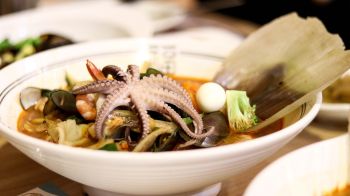
A dish including a juvenile octopus being sold at Congje Diner in Prin
-

Octopuses being hung to dry in Chestok


Dishes[edit | edit source]
Octopus arms are commonly eaten by itself, or in ceviche or tacos. Arroz de polvo is another common dish, it consists of deep-fried pieces of octopus stewed with rice and vegetables.
Delicacies[edit | edit source]
The greater freshwater octopuses is a key component in the Frésirian surf and turf, where a grilled octopus arm is served with steppe bison steak, Wosteaquean lobster claws, and a tail, with shrimp, scallops, and roasted potatoes on the side.
Myths & cryptids[edit | edit source]
Cryptids[edit | edit source]
Several reports of a large greater freshwater octopus have been reported since the 1700s, being sighted at Friedlich Lake. The octopus is said to have an arm span of around 25 meters, this would make it about 1 & 2/3 of a ton. The first sighting was in 1758 when three fisherwomen saw the octopuses emerge near the coast of Friedlich Lake, the octopuses then sat on the sand for about half an hour, and the octopuses then disappeared back under the lake. The most recent sighting was in 2014 when staff sergeant Gisa Rebekka of the Frésirian Republican Land Guard, landed her seaplane to fish in Friedlich Lake, the octopus then reported latching on to the back of the seaplane, the seaplane had a slight incline near the back, a testament to the estimated weight of the octopus. The octopus then swam away after 2 minutes, a picture was taken, although it was in open water, therefor the size of the octopus cannot be confirmed from the image.
Myths[edit | edit source]
Several native Frésirians tribes regard seeing greater freshwater octopuses to be a good omen, and the octopuses to grant luck, and wisdom when throwing animal carcasses into communal grounds near the coast.
The Irrouise tribe of central Frésir has a large octopus-like beast in their religion, it is regarded as a powerful mythological creature. It has crab-like claws and eyes like a hawk, it is said that it uses its preys organs to enhance itself. It is said to live in deep water, and drowns any person, and animal unfortunate enough to get too close.