Feminism in Aredoa
Feminism in Aredoa refers to the social, political, and cultural movements that have sought to address gender inequality and advocate for women's rights within Aredoa. With its roots embedded in the country's revolutionary period, the feminist movement in Aredoa has evolved over time and has been a significant driver in the cause of women's emancipation.
History[edit | edit source]
19th Century: Colonialism and revolution[edit | edit source]
Under colonial rule, women lacked the same legal protections and privileges that were afforded to men. For the entirety of the Colonial Parliament's existence (1823-79), women could not stand as candidates for election, nor vote in elections.

In the latter half of the 1800s, a feminist movement began to grow. In 1865, the movement was centralized as the Women's Society for Equality under the leadership of Xiomara Vallez, a well-known feminist and socialist activist. The Society became one of many organizations to join the Aredoan Cultural Congress, a forward-thinking body striving for self-determination for Aredoa. Feminism soon became a staple of the Cultural Congress, with many women becoming leaders in the growing independence movement.
In 1875, key members of the Cultural Congress ran for election to the Colonial Parliament of Aredoa, intending to seek a mandate for the Congress to act on behalf of the nation. Though women were prohibited from standing for election to the parliament, several women defied electoral laws and stood for election under pseudonyms. 11 women won in their constituencies and would join their male counterparts in refusing to take their seats in the colonial parliament.
When the War of Independence broke out in 1876, a number of women took up arms as members of the Revolutionary Aredoan Army. In addition, further women played supportive and logistic roles for the revolutionaries, such as medics, messengers and bandits, who would famously hold up colonial carts carrying money and supplies at gunpoint.
When Aredoa won its independence in 1879, the new constitution reflected the role that women had played in the revolutionary movement, guaranteeing universal suffrage and expanding access to education for women.
20th century: Rollback of rights and the second wave of feminism[edit | edit source]

During a stretch of conservative dominance from the late 1930s to the late 1950s, many of the progressive gender equality laws were repealed in what was commonly called the 'counter-revolution' by feminists. Women were banned from holding employment after marriage, and women who had children outside of wedlock were often shunned by society. Women could also not petition for divorce, which was reserved exclusively for men.
The second wave of feminism began with the formation of the Feminist Party in 1953. The party held demonstrations and contested elections in the name of full and equal rights for women. The party helped to carry Eva Carrasco of the Social Democrats to victory in the 1957 presidential election and later won 23 seats in the 1959 general election. In the aftermath of the 1959 election, the Feminist Party joined a left-wing unity government formed over opposition to the preceding conservative government and its appeasement of autocratic states in the build-up to the Great War.
In government for over a decade, the Feminist Party spearheaded the government's agenda for gender equality, successfully implementing on-demand abortion, repealing the employment ban on married women, and liberalizing divorce procedures, among other reforms.
Modern women's rights[edit | edit source]
Political involvement[edit | edit source]

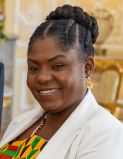
Deputy Chief Minister
In 2014, one of the first moves of the new left-wing coalition government was a campaign by the Ministry of Social Affairs titled "#50by30". The goal of the campaign is to achieve 50/50 gender parity in politics by 2030. A number of steps have been taken to facilitate this goal, such as the expansion of maternity leave and flexible working for members of the National Assembly and Regional Councils, and improving high school and university graduation rates among women. Six of Aredoa's eight mainstream political parties have signed a voluntary pledge to run an equal number of men and women in elections, although as a voluntary pledge there is no punishment for not meeting the quota.
The number of women in politics has significantly increased since the launch of the #50by30 campaign. Following the 2019 general election, women made up a record 43% of the Chamber of Deputies. In 2020, the Chamber of Regions, whose members are appointed by Regional Councils, appointed exactly 60 men and 60 women, achieving gender parity for the first time. The election of Maria Ortalez as President in 2021 was the first election of a woman to the presidency in the 21st century.
Employment[edit | edit source]
The employment rate of women in 2023 is 72.3%, lagging slightly behind the male employment rate of 75.6%. In the last decade, the government has undertaken efforts to increase opportunities for women, such as efforts to encourage women to enter STEM fields, requiring corporate boards to have a minimum of 40% women on the board, and the Equal Pay Act of 2017.
Notable Feminists[edit | edit source]
- Xiomara Vallez, feminist revolutionary and 3rd President of Aredoa.
- Eva Carrasco, 9th President of Aredoa and President during the Great War.
- Emilia Rejas, 12th President of Aredoa.
- Maria Ortalez, 16th and incumbent President of Aredoa.
- Adelaida Sanzano, incumbent Deputy Chief Minister and Leader of the People's Party.